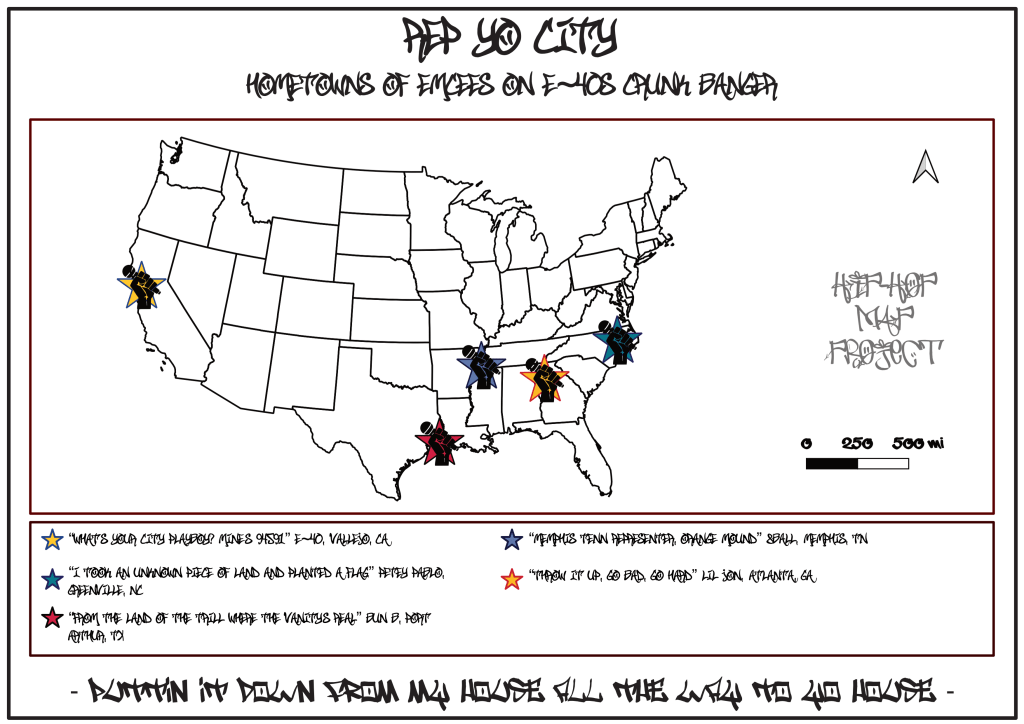
“Rep Yo City” is a perfect song for the Hip=Hop Map Project: five emcees from five different places, all talking about where they’re from. When I first started making these maps I wanted to highlight our culture’s rich bond with geography, and this song sums it up.
If you’re not familiar with the song, “Rep Yo City” was a 2002 crunk banger released on both E-40’s Grit & Grind and Lil Jon & the Eastside Boyz”s Kings of Crunk albums. Led by E-40 and produced by Lil Jon, the song also features guest verses from Petey Pablo, Bun B, and Eightball. Petey Pablo was fresh off of the success of his debut album, and Ball & Bun B were two veterans with careers as storied as E-40’s and Jon’s. If I were to put someone from the New School on to crunk music “Rep Yo City” would be one of the first five songs played.
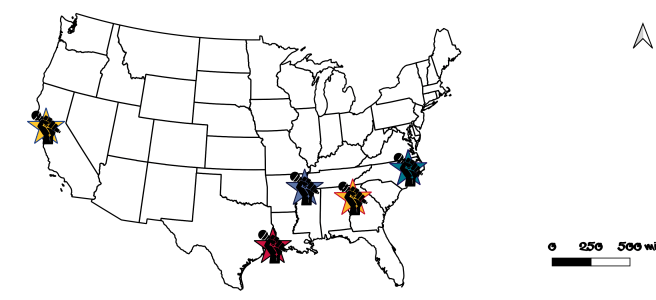
For this one I mapped where each artist was from and matched the location with a lyric in their bars. Each place is symbolized with a mic in hand and start background. I selected NBA colorways for the stars; if you follow E-40 you know he’s an avid sports fan and is often found courtside at Golden State Warriors home games. Each star is symbolized based on the closest NBA team to the emcee’s hometown: – E-40, Vallejo, CA (Golden State Warriors) – Petey Pablo, Greenville, NC (Charlotte Hornets) – Bun B, Port Arthur, TX (Houston Rockets) – Eightball, Memphis, TN (Memphis Grizzlies) – Lil Jon, Atlanta, GA (Atlanta Hawks)
I relocated to Houston from Detroit a few years ago, but I’ve been a fan of the hip-hop scene almost all my life. Thanks to a friend who had family in Texas and a little help from OG Napster, I spent countless hours in middle and high school listening to UGK, Scarface, The Screwed Up Click, Swisha House, and more. DJ Screw, the godfather of the slowed down sound, will always have a seat on my Mt. Rushmore of DJs (RIP). It’s only right my second hip-hop city map is dedicated to H-Town, Space City, Clutch City, The City of Swang/Drank/Screw/etc.
When figuring out where I wanted to go with this map, I decided early on NOT to make a map similar to my Detroit one. Although I’m a Houston rap fan, I don’t think I’m knowledgeable enough to create a comprehensive list of OG and new school Houston emcees to match what I did for Detroit. Plus it was extremely labor intensive, and I’m working on streamlining my process to publish more maps without sacrificing quality. Instead I decided on mapping a dope song-well, two songs-I think embodies the city well: Slim Thug’s “Welcome to Houston”.
Slim Thug is a dope emcee with a 20+ year career and a legend in Houston and beyond. I chose “Welcome 2 Houston” because both variants showcase a wide range of Houston emcees and share a ton of local geography. The first version, released in 2009 on his second studio album Boss of All Bosses features Chamillionaire, Paul Wall, Mike Jones, UGK, Lil’ Keke, Z-Ro, Trae the Truth, Rob G, Lil’ O, Big Pokey, Mike D, and Yung Redd. The second iteration, released in 2017 on his ninth album Welcome 2 Houston, features Delorean, Doughbeezy, GT Garza, Killa Kyleon, and Propain. The 2009 version shouts out 11 neighborhoods and 13 roads in Houston, mapped in a manner similar to my previous maps. However, for the 2017 version I highlighted something different.
The 2017 “Welcome 2 Houston” music video shows all six emcees rapping in various parts of Houston, so I mapped those locations: – Slim Thug is at the #TEAMHOUSTON mural at 2102 Commerce Street (note: this building has since been redeveloped and the mural is no longer there). – GT Garza is at the corner of Avenue B and N Cesar Chavez Boulevard. – Propain is at Screwed Up Records & Tapes on Houston’s Southside, where you can still buy OG Screwtapes. – Killa Kyleon is at the basketball courts at Patrick Milton Park. – Delorean is Downtown, on the roof of the Avenida North Garage parking structure next to the George R. Brown Convention Center. – Doughbeezy is walking Downtown, starting from the corner of Austin and McKinney Streets.
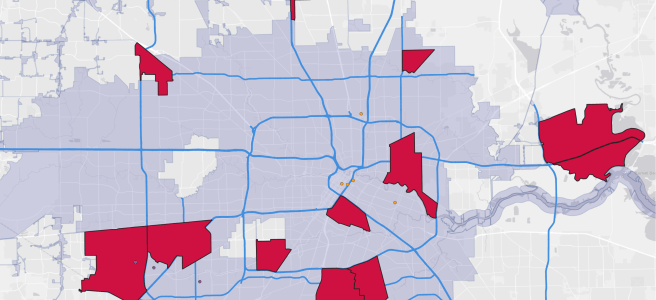
Most of the data to build this map is from the City of Houston’s Open Data Portal. I used their Super Neighborhoods layer to find most of the neighborhoods (one, Scenic Woods, I had to draw manually), the Major Thoroughfare and Freeway Plan for major roads, and of course the city limits. One neighborhood, Channelview, is technically a Census Designated Place outside of Houston, so I used the open data portal of the Houston-Galveston Area Council, the regional planning entity, to find it. And of course the symbology is inspired by local sports colorways: neighborhoods in Rockets red & white, roads in OG Oilers blue, and music video locations in Astros orange and navy. The city limits are a shade of blue from the city government’s official style guide, which kind of looks purple-ish when you adjust the opacity. If you know you know.
This map was super fun to make. Houston continues to show me mad love. The people are great, the food is amazing, and although I’m publishing it during a record-breaking heat wave the weather ain’t that bad either.
I’d argue that Nelly is one of the archetypes of the hip-hop crossover smash artist. He’s done records with pop divas, boy bands, country superstars and the like. All while staying true to his roots and maintaining a high level of lyricism.
Imagine it’s 1999, 2000, and you’re an emcee from a city relatively unknown in the national hip-hop conversation (St. Louis, Missouri). God-Tier emcees are killing the game. Jay-Z and Snoop Dogg are 4-5 albums deep each. Nas is 4 albums deep. DMX is 3 deep. Cash Money, No Limit, OutKast and Three 6 Mafia are synonymous with the Southern Takeover. Eminem is a young phenom skyrocketing to the top of the charts. Not to mention Rawkus Records is uplifting the underground across the airways. You had to be at the top of your game to be thought of, let alone recognized in a sea of competition.
Nelly did just that with “Country Grammar”, the first single off his debut album of the same name. When I heard it for the first time there was nothing like it on the radio. He had an insane melody to his flow that when paired with interpolating a kids playground rhyme on the hook, made the song unstoppable. And the music video painted him as the hometown hero that he is. I remember as a teen wanting to go to a block party in St. Louis just to see if they got down like that, it looked like a great time.
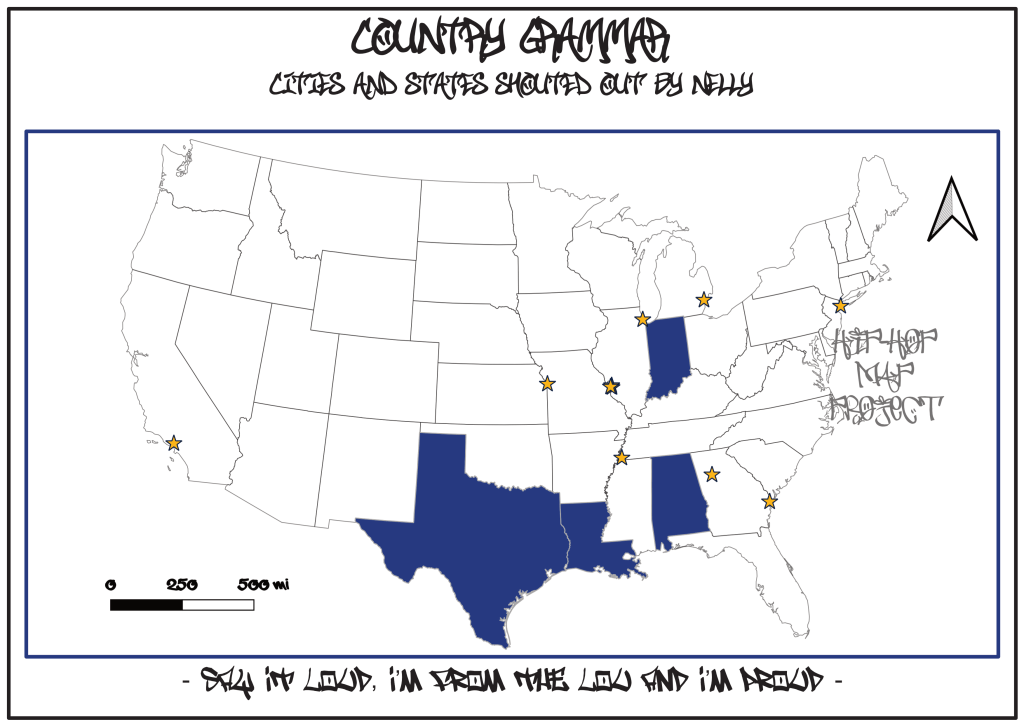
In the song Nelly shouts out a few cities and states that are no strangers to speaking that country grammar, albeit some not even in the American South. In total Nelly lists 16 places: 4 states, 11 cities, and one street. The street, Kingsland Ave, is obviously not shown due to the scale of the map. The symbology is derived from the uniform colors of the St. Louis Blues, with blue states and yellow stars for cities.
States: Texas, Indiana, Alabama, Louisiana.
Cities: St. Louis, MO; Memphis, TN; Chicago, IL; Kansas City, MO; Detroit, MI (Motown); Los Angeles, CA; New York City, NY; Atlanta, GA; Savannah, GA; Jennings, MO; University City, MO.
One of these days I’m going to write an essay on how my character arc in this thing called life weaves seamlessly at times with the release schedule and subject matter of David Banner’s discography. He’s been on of my favorite emcees and producers for the last 20 years, in my CD changer since CD changers.
Being the self-proclaimed Hip-Hop Geographer, of course I have a few location-based memories of him. One of the oldest involves Mississippi…the Album Chopped & Screwed. My cousins and I dated a group of friends from Mount Clemens, Michigan in the summer of 2004. We’d turn on the album when we left our neighborhood in Ecorse and by the time we were ready to exit the freeway “Choose Me”, his song about wooing the women-ladies featuring Skyy, would come on. I think even a few of us were dating someone who shared a name on the list sung in Skyy’s verse. Mississippi…Chopped & Screwed is still one of my favorite albums of all time, and one I rarely want to hear at regular speed because of that summer. I would have similar adventures through college and my 20s with Banner supplying the soundtrack.
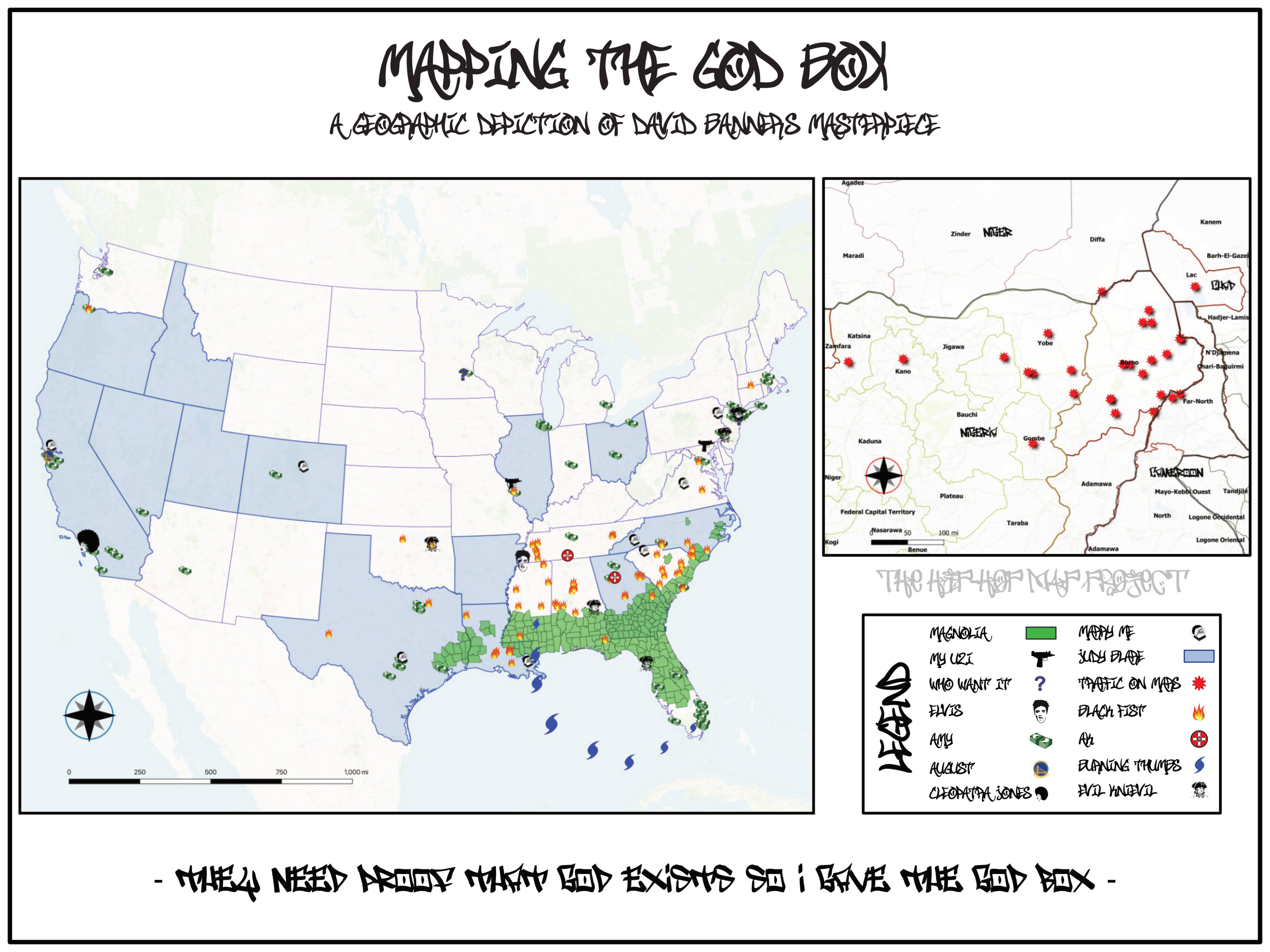
I felt it only appropriate to map his most recent album (as of writing this), The God Box, which should be on everyone’s Black Power Playlist. It’s the perfect blend of critiquing systemic racism and unjust institutions, discourse on the state of Black America, and the raw, aggressive rhymes he and others from the Hip-Hop South are known for. I discovered album at a time older and wiser than before, where I too was reflecting on the ways of how we live and thinkin of what I can do to contribute positively to my people. As always, David Banner gave me some bangers to nod my head to while I move about the world.
For each track I mapped a layer inspired by the lines or messaging within the songs. The only exception is “Wizdom Selah,” which if you’ve listened to the track you’d probably agree with me that this map IS my Wizdom Selah. This map took a year to build and I’m happy to share it with you, and hopefully David Banner too: if you see this I have a printed copy on deck for you.
TRACK LISTING:
“Magnolia” (How she was used in the lynching of Blacks / Branch cracked broke her arm so his neck wouldn’t snap)
Magnolia grandiflora, most commonly known as the southern magnolia, is a large evergreen tree ubiquitous with the South. It grows naturally throughout much of the southern United States and is the state tree of Banner’s home of Mississippi. Due to its size and sturdiness it also has a history of being used in lynchings. In an interview with Fuse, Banner says the inspiration for Magnolia came from an idea for a book: If Trees Could Talk would have given trees the ability to say what they’ve witnessed over centuries, to include the deaths of Black men, women, and children under their branches. I really hope he writes it.
Symbolized in green are counties where the southern magnolia grows naturally. The US Forestry Service’s USDA Agriculture Handbook has maps of the habitats of various American trees and plants. I interpolated the map of the southern magnolia’s range into a by-county depiction.
“My UZI” (I been on one since they killed Mike…They say this shit is about black and white / All this shit is pretty Freddie Gray)
“My UZI” is not just a song about firearms, it’s a call to action for Black communities to defend and protect themselves. David Banner and Big K.R.I.T. speak on police brutality in their bars, most notably the deaths of Michael Brown and Freddie Gray. Brown and Gray were two young Black men killed by law enforcement officers in 2014 and 2015 respectively. Both incidents became national news headlines due to the large-scale protests in response to the killings.
The Uzis on the map show the cities of Ferguson, Missouri and Baltimore, Maryland, the cities where Michael Brown and Freddie Gray were from.
“Who Want It” (Kneel to the Almighty / It’s my second time asking what happened to Chris Lighty or Prince)
Raw rhymes. Pure emceeing. David Banner and Black Thought pull no punches on “Who Want It”. Banner references the deaths of Chris Lighty and Prince, two well-known names in the music industry, in his verse. Chris Lighty was a record executive and co-founder of the Violator record label. And Prince, well who doesn’t know Prince.
Both Lighty and Prince were found dead; Chris by a self-inflicted gunshot wound and Prince by accidental overdose. Additionally, both deaths are questioned to this day as fan and family members share disbelief of the coroners’ dispositions. The purple question marks show where they passed away: Lighty in New York City and Prince at his Paisley Park estate in Chanhassen, Minnesota.
“Elvis” (Lord don’t take my heart, Lord don’t take my soul / Lord don’t let them take hip-hop like they took rock & roll)
Banner raps about the whitewashing of Black music in “Elvis”. He discusses contemporary white artists who find success in creating Black music-Eminem, Justin Timberlake, Robin Thicke, and Adele to name a few-and white ownership of Black media distributors like Black Entertainment Television. Although BET is run by African American executives it is still a subsidiary of a larger corporation, most recently Paramount Global.
Elvis Presley is a widely-known archetype of white artists capitalizing from popular Black music. Elvis’ head shows the location of his estate in Graceland, Tennessee.
“Amy” (F*** Gucci, f*** Louie, till they come to my hood / F*** Tom Ford, f*** Versace, yeah I said it I’m good)
“Amy”, short for Ay My N****, explores the dichotomy of our most beloved and most hated racial epithet as Black Americans and how our feelings about the word change depending on who’s using it.
Banner’s bars above reference a relationship luxury brands have with hip-hop artists and Black consumers that may not be seen as mutually beneficial. It’s no secret luxury brands have profited from the free advertising of hip-hop artists since Dapper Dan was making Gucci coats for Eric B & Rakim (maybe even more). Only within the last decade or so these brands started incorporating emcees (and urban/R&B artists as well) in their ad campaigns and we now see these artists at the forefront of fashion weeks worldwide.
What may not be that well-known is how often Black America sets trends in luxury goods outside of the music. According to a Nielsen consumer report published in 2019, Black America has $1.3 trillion in annual spending power. If we were our own country we would have the 15th largest GDP, more than Mexico, less than Spain. And Black consumers are more likely to spend on luxury items: the report says Black people were 31% more likely to spend $500 or more on handbags or purses within the past year.
The irony is although we patronize luxury stores at higher rates and spend more money very few, if any, have locations in predominantly Black neighborhoods. The money stacks symbolize all of the Gucci stores in the United States. Don’t be fooled by the scale of the map: although many are near core cities, these stores are almost always located in suburbs and exurbs well beyond the city boundaries.
“August” (Chef Curry, no pot, Klay Thompson in the third against Sac with the Glock / Thirty-seven, block, block, yeah I’m conscious but the pistol that I got still pop / I need every Igoudala…)
Short, but powerful, “August” is raw rhymes over a beat I’d classify as boom-bap-meets-808-funk. The first half of Banner’s verse is an extended metaphor incorporating the Golden State Warriors roster. He calls out to the January 23, 2015 game against the Sacramento Kings where Klay Thompson set the NBA record for most points in one quarter (37). The Klay Thompson bar also serves as a double entendre as the Glock 37 is a popular firearm. The Warriors logo shows the location of their home arena, Chase Center in San Francisco, California.
“Cleopatra Jones” (An opulent chick (what’s opulent?) rich / She Sheba, she look like a diva / She move like a Davis / Don’t play us, she spray us, she stay on some Angela shit)
“Cleopatra Jones” is an ode to the Black woman in name and verse. The track title was likely inspired by the 1973 Blaxploitation film Cleopatra Jones starring Tamara Dobson. Dobson plays a US Special Agent who takes on international drug cartels.
I chose to map something from the movie. The filmmakers used the Granada Buildings in Los Angeles for exterior shots of Cleopatra Jones’ home. The buildings-technically one complete structure-currently hosts 56,000+ square feet of office and studio suites. The buildings are symbolized by a Black woman with an afro, one of Cleopatra’s signature looks in the film.
“Marry Me” (I will wrap my soul around this ring girl / If I could that’s what you mean to me / Give me your hand and your heart girl / I swear it’s safe for eternity)
Marry Me is a great love song Mrs. Smithsonian and I would have probably worked into our wedding ceremony if we had one. We got married in 2020, you can dig the hint. Nonetheless, the perfect destination to have a wedding seemed fitting to add to the map. The engagement rings symbolize Travel Noire’s 2019 list of the Top 10 Most Beautiful Destinations for a Fall Wedding: – Pippin Hill Farm & Vineyards, Virginia – Pocono Mountains, Pennsylvania – New York, New York – New Orleans, Louisiana – Denver, Colorado – Austin, Texas – Asheville, North Carolina – Napa Valley, California – Spartanburg, South Carolina – Cancun, Mexico (not shown)
“Judy Blare” (We’re being taken over by domestic terrorists. Those domestic terrorists will not allow you to collect rain water. Water is the essence of life. It’s the one thing we cannot survive without. And when they privatize it, we’re all fucked.)
These aren’t bars from the song; instead, they’re from the dialogue that plays after the song ends. Symbolized in blue are the 13 states that restrict or otherwise regulate rainwater harvesting according to the World Population Review: Arkansas, California, Colorado, Georgia, Idaho, Illinois, Louisiana, Nevada, North Carolina, Ohio, Oregon, Texas, Utah.
“Traffic on Mars” (There’s murder for minerals in Ghana / So I’mma blow this marijuana / In honor of all the daughters and mamas that live under Boko Hiram)
“Traffic on Mars” is a play on the feeling from smoking cannabis; people often say they’re so high they’re in outer space or on another planet. I hear Banner flipping this by showing although he may be high, he’s not clouded to the problems of Black people across the world. The bar above calls out the evils of Boko Haram, a Nigerian terrorist organization notoriously known for their attacks on women and children, particularly young girls. Wikipedia has an article listing Boko Haram’s attacks going back to 2009. The explosions on the map of North-Central Africa symbolize Boko Haram attacks deliberately targeting women and children, to include those where female suicide bombers were used to carry out attacks.
“Black Fist” (These crackers got drones, they are flying their saucers / Keep your white Jesus, don’t pray to your crosses / They are burning our churches, K.R.I.T. pass me the UZI / I know how to work it, I know how to squirt it)
“Black Fist” is a call to arms against systemic violence on the Black community and should be a song on everyone’s Black Power Playlists. Both Banner and Tito Lopez give amazing verses that identify root causes of racism as it exists today. Banner references church burnings, a tactic used against Black communities for decades, in his bars. The fires symbolized known arsons and firebombings of Black churches according to Wikipedia. Some churches have since relocated-or never rebuilt-so I guesstimated some locations by sifting through news articles and other sources.
What surprised me most while I mapped this layer was the number of arsons that occurred in the 1990s. I assumed most of the church burnings occurred between the mid-19th and -20th centuries and tapered off after the Civil Rights Movement. However, apparently while I was minding my business in elementary school there was a streak of arsons across southern Black churches so significant, it motivated Congress to pass the Church Arson Prevention Act. I had no idea this was going on; although in elementary school my teachers taught us about current events like the Rodney King trial and the Million Man March, Black church burnings weren’t brought up. Maybe in their opinion it was too graphic to share with children. I can dig it.
“AK” (I’m from the land of the KKK, where the AK’s spray / Where your baby mama sell 30 rock like Tina Fey aye)
“AK” is dedicated to David Banner’s home of Mississippi and the living conditions for many Black communities within. Unfortunately it’s estimated over 1,000,000 African-Americans living in Mississippi are in poverty, and Black neighborhoods often still feel the effects of racism today. In his bars Banner calls out the Klu Klux Klan, an organization ubiquitous with white supremacy and domestic terrorism. The KKK has a presence across the American South and beyond, but only two places can claim its birthright. There were two iterations of the KKK: the First Klan was founded in Pulaski, Tennessee in 1865, and the Second Klan was founded in Stone Mountain, Georgia in 1915. Both locations are symbolized by AK-47 rifles as a shout out to the song’s title.
“Burning Thumbs” (What if God already came and we missed the damn boat / Ask Katrina Black folks don’t float so well)
“Burning Thumbs” almost sounds like a psalm to me. Not quite rapping, not exactly singing, set to a guitar and soft drums in the background. In a lamenting tone similar to his hook on “Cadillac on 22’s”, Banner asks the listeners to put their lighters up until they burn their thumbs, referencing crowds waiving lighters in the air at concerts (although now you’re more likely to see smartphone screens).
Banner mentions Hurricane Katrina in his bars. Katrina devastated the Gulf Coast in 2005. She landed as a Category 5 hurricane, taking at least 1,800 lives and causing over $125 billion in damage. Although most of the national story focused on New Orleans, Hurricane Katrina devasted coastline (and inland) communities across Louisiana, Mississippi, Alabama, Florida, and beyond.
The blue hurricanes symbolize the path of Hurricane Katrina according to the National Oceanic and Atmospheric Administration, which maintains an archive of hurricane patterns. The shapes grow and diminish in size in proportion to the hurricane’s category at that location.
“Evil Knievil” (How you say that don’t affect us / Tuskegee how you let them infect us?…This is for Tulsa, Oklahoma this for Rosewood / This for Philly when the cops bombed the whole hood / This for Harlem when the pigs stop and frisk / All my folks from the Congo tell Belgium suck a, suck a)
In OutKast’s “Reset” Khujo Goodie interpolates Ephesians 6:12, the bible passage that teaches about the Armor of God and that we are not at war with people, but with “principalities, against powers…spiritual wickedness in high places” (KJV). I see “Evil Knievel” as a counter, not to Khujo’s verse in particular, but the idea that evil isn’t personified.
Banner calls out five locations of white terrorism in the song: Tuskegee, Alabama (the Tuskegee Experiment); Tulsa, Oklahoma (the destruction of Black Wall Street); Rosewood, Florida (a predominantly Black town burned down by white supremacists in 1923); Philadelphia, Pennsylvania (a Black neighborhood was air bombed in 1985); and Harlem, New York (referencing New York City’s “Stop and Frisk” policy, which advocates say disproportionately targets young Black and Hispanic men).
These locations are symbolized by George Washington’s likeness. The cover art to the song features a collage of the US Presidents over time. Additionally, Banner uses a few president names in his punchlines: Barack pushed hope, Reagan pushed dope…
“Wizdom Selah” (When I think about things…they happen. I can actually do…what I think about. I’m so powerful, I need to give more honor to that. The divine power in, me, and be deliberate)
This map, and arguably the Hip-Hop Map Project as a whole, is my “Wizdom Selah”. All this started as a way to figure out how to retain my GIS skills, and now it’s manifesting into a larger concept, a larger conversation about hip-hop. I will continue to use geography to influence the culture as I create and tap into my divine power.
Sources. Not an exhaustive list, but it will get you on your way if you want more context on the layers:
Crunk music’s been a staple in my playlist since I was a teen. Three 6 Mafia, Lil Jon & the East Side Boyz, and the Ying Yang Twins-some of crunk’s most widely known names-and their 808-laden songs rattled systems from their hometowns of Memphis, Tennessee and Atlanta, Georgia all across the country, to include my neck of the woods in Detroit. Although some gave it a bad rap for being “violent”, in my opinion the music wasn’t much different than the rock songs kids were jumping in mosh pits to. Now a days you can hear crunk’s influence across not just hip-hop, but in pop and other genres too. Project Pat is being sampled on Billboard charting songs. Lil Jon’s voice is heard on electronic music mega hits. Phonk, a sub-genre of lo-fi hip-hop, often slows down drum breaks or other elements of crunk instrumentals in its architecture.
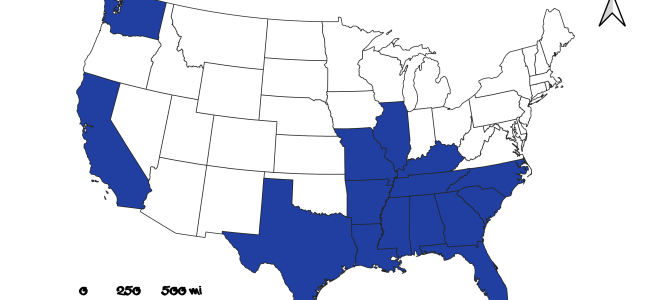
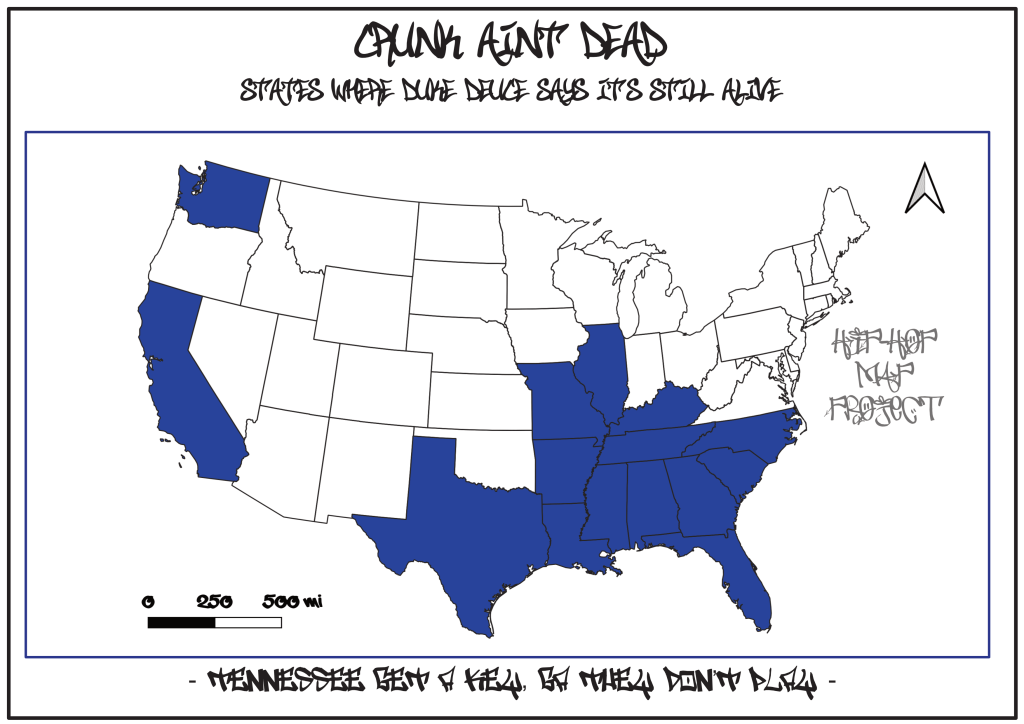
With that being said, Duke Deuce was right in exclaiming “Crunk Ain’t Dead” in his single titled the same. Deuce is a Memphis emcee keeping crunk alive for the New School, known for his high energy music and music videos, and funny shorts on social media. If you’re a fan of “Triple 6” and the like, definitely give him a listen. In “Crunk Ain’t Dead” Duke Deuce shouts out fifteen states: – Tennessee – Georgia – Texas – California – Louisiana (The Boot) – Florida – Arkansas – The Carolinas – Mississippi – Alabama – Illinois – Kentucky – Washington – Missouri All are symbolized in a deep blue as a nod to the music video, which is edited to mute all colors to gray-scale except for blue.
I will always think of The Game as the emcee who tapped into the vibe of late-80s/early-90s West Coast gangsta rap and brought it to the next generation. His music often interpolates or re-samples classic songs by NWA, DJ Quik, Ice-T, and of course Dr. Dre-who would sign him to Aftermath Records. He’s among hip-hop’s elite, possessing formidable skills on the mic and a discography boasting several albums that hit #1 on the Billboard charts.
The Game’s most widely-known trait is his repeated use of name-dropping in his lyrics. The Merriam-Webster dictionary defines name-dropping as “the studied but seemingly casual mention of prominent persons as associates done to impress others”, and the hip-hop world buys into the phenomena wholeheartedly. Emcees drop the names of notable collaborators, producers, and celebrities in their lyrics: often by associating themselves with them or conducting wordplay with their names. For example, in the song “Bach to Bach” Fabolous rhymes “Quarterback life, people wanna pass you sacks / Matte black Maybach I named it Matt Hasselbeck”. This of course is a nod to NFL Pro-Bowl QB-turned-analyst Matt Hasselbeck. Game does this on a grandiose scale and his usage of proper nouns in his lyrics is arguably higher than any other emcee. I decided to conduct a count of his name drops and map them.
Method/Criteria: Using the Original Hip-Hop Lyrics Archive (OHHLA.com) and Genius.com I took note of everyone mentioned in The Game’s studio albums-no mixtapes-counting frequency of unique names and total name drops by album. I sorted the names into 17 categories loosely based on professions (athlete, musician, politician, etc.) to assist with later analysis. The only names omitted were fashion designers: Louis Vuitton, Tom Ford, (Mario) Prada, and the like. I didn’t include them at first, and when I though to start I was a few albums into the count and didn’t want to start over. Exceptions are Dapper Dan, Virgil Abloh, and basketball players with sneakers.
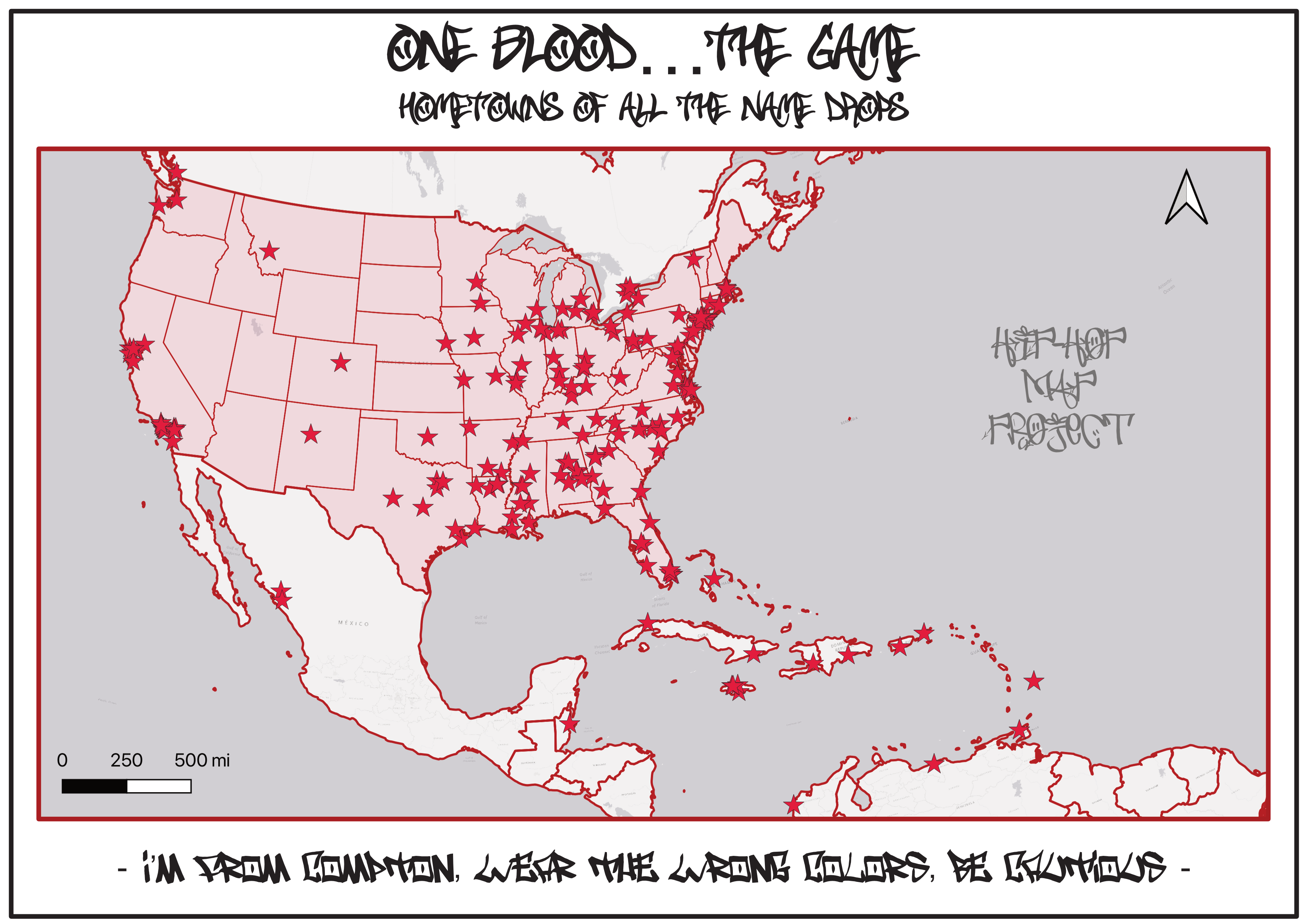
Everyone was mapped based on their hometowns or cities they were most known from. For example, Serena Williams was born in Saginaw, Michigan, but is notably from Compton, California. I aggregated location information to determine if The Game favors name-dropping people from any region in particular. Of course all points are symbolized as a nod to The Game’s membership in the Bloods.
Findings: Based on my counts The Game made a total of 1,094 name drops (averaging 109.4 per album) and mentioned 650 unique names. Based on album: – The Documentary: 130 – Doctor’s Advocate: 84 – LAX: 123 – The R.E.D. Album: 96 – Jesus Piece: 96 – The Documentary 2: 98 – The Documentary 2.5: 100 – 1992: 119 – Born 2 Rap: 102 – Drillmatic: 146 The Game’s top 5 name drops are Dr. Dre (148 times), 2Pac (75), Biggie (47), Jay-Z (42), and Kanye West (40). Dre, Pac, Kanye, Nas, and Snoop Dogg are mentioned at least once per album.
He drops musicians, record executives, politicians, fellow gang members, models, actors and actresses, and even terrorists (al-Qaeda and ISIS are both mentioned in his songs). Musicians are shouted out the most by far (377 total), followed by 85 athletes and 45 fellow gang members. He also name drops the family members (parents, spouses, and children) of 10 emcees.
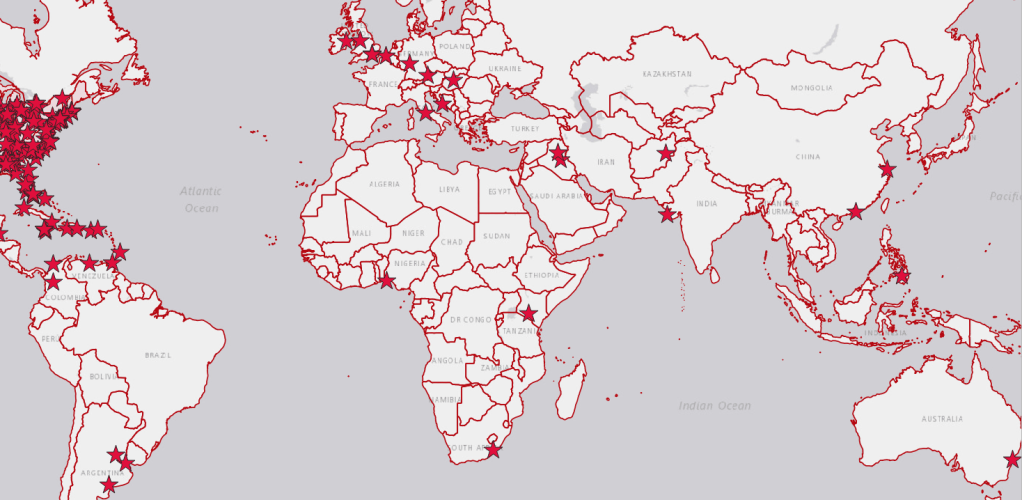
Geographically a total of 36 states, two US Territories, the District of Columbia, and 30 countries are represented.
Elite Emcees: The Game has a penchant for shouting out emcees on the top of the food chain, just look at his top 5 above. Other emcees with more than 10 name drops that are top-tier in my opinion are Eminem (35), Lil Wayne (23), Kendrick Lamar (18), and Ice Cube (13).
G-Unit: The Game’s affiliation and subsequent beef with 50 Cent and G-Unit are well known in the hip-hop community. It should be no surprise The Game name drops them in both friendly and threatening bars. He calls out 50 Cent’s name the most at 35 times, and the rest of G-Unit a total of 15: Lloyd Banks (5), Young Buck (5), Tony Yayo (4), Sha Money XL (1).
West Coast Love: The Game is from Compton so of course there were more name drops of Californians than those from any other state (155). New York was a close second (143), mostly due to shouting out hip-hop veterans.
Errors/Omissions: See my notes above regarding omitting fashion designers. I also realize my numbers are quite different from other great rap data sources like Hip-Hop By The Numbers, and even by The Game’s own count, so the possibility of my own human error isn’t out of the question. I will say I come damn close though. I did my counts by hand, writing out every name drop song by song, album by album. I’m happy to share my summary tables and data with anyone who has a different count.


 Rap GEO